Since I don't smoke or drink and swear unconvincingly, symmetry is my only vice.
-Richard Powers, Three Farmers on Their Way to a Dance
Showing posts with label books. Show all posts
Showing posts with label books. Show all posts
Monday, April 04, 2011


Wednesday, March 02, 2011
The Wise Man's Fear Book Signing in Seattle

I will pause here a moment and offer further mad props to my homegirl Suey, who not only saved me the aforementioned spot, she also told me about the event in the first place, which I was ignorant of, having been eye-deep in the day-to-day grind of writing my own novel on a looming if self-imposed deadline.
Those of you that follow this blog may recollect my recent extended squee over the first book in the Kingkiller Chronicles, The Name of the Wind, some two weeks ago. I had been saving the book for most of a year before I read it, for various reasons, and I enjoyed it most thoroughly. I seem to have done something right, albeit unconsciously, because unlike most of the rest of Mr. Rothfuss' fans, I did not have to wait long for the next book, and indeed I purchased a copy yesterday for him to sign.
But enough about me.
Thursday, February 17, 2011
The Name of the Wind, by Patrick Rothfuss

The night before I flew home, I think I got five hours. The night before that, no more than 3 1/2. I had a 13+ hour day of flying to get back (from Florida to the Pacific Northwest, with not one but two layovers). It was actually still dark when I got up and got going to the airport.
I had more than a couple of drinks, and took a painkiller for my back. I was exhausted.
You would think I would have slept away the hours on those flights. Any sane person would. More than once, I thought for sure that my eyes were just going to roll into the back of my head and I would have to be shocked awake with a defibrillator to get me off the plane.
But I did not sleep, because I was reading The Name of the Wind, and all I wanted to do was keep reading. So I did, until I finished it.
Sunday, October 10, 2010
Reading and Writing 10/10/10
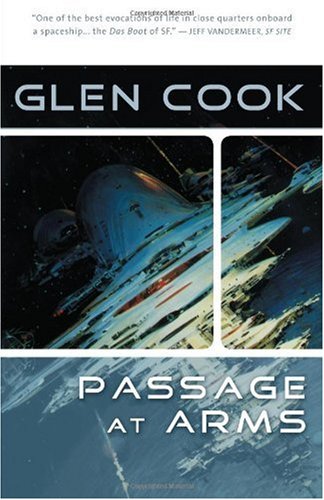
My earliest encounter with his work was the first three or four books of The Annals of the Black Company and, later, The Garrett Files, back when I was just a wee young whelp blazing through as many tomes from the Fantasy and Science Fiction Book Club as I could get my hands on. Later, I read (and loved) The Dragon Never Sleeps, a stand-alone space opera that I found a used copy of a couple of years ago and read again. To my great delight, it was just as good, if not better, the second time around.
So when I recently found myself gazing upon the vast to-read pile that adorns my bookshelves, with an (oddly rare these days) opportunity to read whatever I wanted, I leapt at the chance to read Passage At Arms, one of his lesser known works, a military SF standalone that is, in the words of my esteemed Clarion instructor (and literary hero) Jeff VanderMeer, the "Das Boot of SF." If you look at the picture above closely enough, you can see where he says it, there at the top, above Cook's byline.
Synoptically speaking, Passage at Arms is a first-person narrative account of one ship's patrol into unfriendly space during a protracted war between humanity and an alien race called the Ulant. Told from the perspective of a discharged Navy Lieutenant turned war correspondent, the story revolves primarily around the claustrophobia and paranoia of the crew on their months-long patrol through the vicissitudes and uncertainty of war in space. Despite its science fictional premise, there's a certain verisimilitude here that really brings things home. The narrow focus on surviving the present; the lack of information; the contempt for Command: it all rings true. It all sounds like what it's really like to be at war, or would be, under those circumstances.
Monday, October 04, 2010
Reading and Writing 10/4/10

Why? you ask. Well, I'm glad you did (which is why I did it for you).
Monday, May 17, 2010
Delia Sherman's Changeling

That said, I'm really glad I did read it, because I really liked it.
Set in New York Between, a sort of fairyland version of NYC populated with imaginary monsters and spirits from all over the world (not unlike the real city), Changeling is the story of Neef, a mortal child stolen by the fairies and replaced with one of their own (which is what a changeling is, btw), who breaks the rules of the Genius of Central Park and has to go on a quest in order to return to her home and the life she has always known.
Like many a YA fantasy heroine, Neef is long on moxie and short on foresight. She knows the rules (we all do, because we all grew up listening to fairy tales, which are really valuable life lessons disguised as parables and stories and where the negative consequences of foolish actions are exaggerated for pedagogic effect), but she's at that age where rationalization and the beginnings of adolescent entitlement start to blind us all to the realities of the world as it is (as opposed to how we think it ought to be). We've all been there: old enough to know better, but young enough to do it anyway and rationalize after the fact. Of course, she learns some valuable lessons along the way, and everything comes out alright in the end; but, as with all quest tales, the journey is the destination. And for the reader it's an enjoyable, engaging page-turner of a journey.
Friday, May 14, 2010
Jeff VanderMeer's Ambergris Cycle
Thanks to a bout of unexpected travel (with its attendant lengthy spans of time in which one is obliged to sit in place and do, essentially, nothing, during which a good book (or two, in this case) can really come in handy for the whole staving off boredom, madness, and anxiety thing (painkillers also work, but are not nearly so entertaining)), I have recently had the opportunity to finish the second and third books of Jeff VanderMeer's Ambergris Cycle, Shriek: An Afterword and Finch.
Being that Mr. VanderMeer will be one of my instructors this summer at the Clarion Writers' Workshop, I'm going to do my best not to gush here, as there is some small chance he will read this and it would not be seemly and could conceivably make things a bit awkward come the end of July. But given that his presence at the workshop was the primary driver behind my application (I was perfectly content being all autodidactic and such until I realized I'd have a chance to work with him and the other stupendous badasses who will be teaching there this year), the possibility exists that I will not be able to stop myself.
But the truth of the matter is that I love these books, and am amazed and inspired by them, as individual works and, most especially, as a whole. I'm going to do my best not to spoil them for anyone who might be inspired to give them a read, but there's a lot of formal innovation and dialogic interplay that I'd like to suss out and explore, because I'm so bleepin' impressed with it. I think I should be able to do what I want to do without unduly exposing the overall narrative arc of the cycle or ruining the enjoyment of the story as such. If I do, apologies in advance.
Being that Mr. VanderMeer will be one of my instructors this summer at the Clarion Writers' Workshop, I'm going to do my best not to gush here, as there is some small chance he will read this and it would not be seemly and could conceivably make things a bit awkward come the end of July. But given that his presence at the workshop was the primary driver behind my application (I was perfectly content being all autodidactic and such until I realized I'd have a chance to work with him and the other stupendous badasses who will be teaching there this year), the possibility exists that I will not be able to stop myself.
But the truth of the matter is that I love these books, and am amazed and inspired by them, as individual works and, most especially, as a whole. I'm going to do my best not to spoil them for anyone who might be inspired to give them a read, but there's a lot of formal innovation and dialogic interplay that I'd like to suss out and explore, because I'm so bleepin' impressed with it. I think I should be able to do what I want to do without unduly exposing the overall narrative arc of the cycle or ruining the enjoyment of the story as such. If I do, apologies in advance.
Friday, April 23, 2010
Tuesday, March 16, 2010
What I'm Reading
I've got a couple of books going right now, both of which are pretty deep. And though I'm reading them for different reasons, and started them at different times, there seem to be some interesting confluences. Both are deeply literary, by which I mean both seem intent to delve into the depths, not only of the human psyche, of the lived experience of being a person in a particular place and time, but also of history, as well, although in a more metaphorical than literal sense. And both seem to revolve around themes of alienation between the two.
 First is Roberto Bolano's 2666. I have, thus far, only read three of the five novellas that comprise 2666, or about half of the total page count. There's a note in the beginning from Roberto Bolano's heirs to the effect that his plan had been to publish the five separately, so as to maximize the economic returns that his heirs would enjoy from his posthumously published work (he died in 2003). Having read them, though, they decided that the work was best served being published together in its entirety, a decision I applaud and am grateful for. As it is, my reading of this book has been staggered and interrupted enough. It's tricky stuff: easy enough to read in terms of the density of prose and meaning, but the cumulative effect is strangely overwhelming. But I'm halfway through and I'm just starting to understand (I think) what he's doing here, and I think if the books had been released separately that it would be more difficult to get that sense.
It may be that I'm writing this too early. After all, I have yet to begin Book 4: The Part About the Crimes, in which the murders of hundreds of women in Santa Teresa, the northern Mexican city that serves as the crux of the work will, presumably, be explored directly, rather than simply serving as a sort of background, as history does to life. But I feel as if I've gotten through enough to at least put down some preliminary thoughts.
Nearly all the protagonists, thus far, seem to have a few things in common: they are people of letters, mostly literary critics and university types, with one journalist who writes for a specialty magazine; each seems to be only marginally in control, of themselves and their lives; and each is drawn, for very different reasons, to Santa Teresa, which lurks in the background almost menacingly as they live some portion of their lives there.
 First is Roberto Bolano's 2666. I have, thus far, only read three of the five novellas that comprise 2666, or about half of the total page count. There's a note in the beginning from Roberto Bolano's heirs to the effect that his plan had been to publish the five separately, so as to maximize the economic returns that his heirs would enjoy from his posthumously published work (he died in 2003). Having read them, though, they decided that the work was best served being published together in its entirety, a decision I applaud and am grateful for. As it is, my reading of this book has been staggered and interrupted enough. It's tricky stuff: easy enough to read in terms of the density of prose and meaning, but the cumulative effect is strangely overwhelming. But I'm halfway through and I'm just starting to understand (I think) what he's doing here, and I think if the books had been released separately that it would be more difficult to get that sense.
It may be that I'm writing this too early. After all, I have yet to begin Book 4: The Part About the Crimes, in which the murders of hundreds of women in Santa Teresa, the northern Mexican city that serves as the crux of the work will, presumably, be explored directly, rather than simply serving as a sort of background, as history does to life. But I feel as if I've gotten through enough to at least put down some preliminary thoughts.
Nearly all the protagonists, thus far, seem to have a few things in common: they are people of letters, mostly literary critics and university types, with one journalist who writes for a specialty magazine; each seems to be only marginally in control, of themselves and their lives; and each is drawn, for very different reasons, to Santa Teresa, which lurks in the background almost menacingly as they live some portion of their lives there.
Sunday, January 03, 2010
What I'm Reading
 I've got a couple of books going right now, both of which are making me very happy.
The first is City of Saints and Madmen, by Jeff Vandermeer. It's compilation of novellas and short stories of or otherwise having to do with the fictional city of Ambergris. Vandermeer was recommended to me by my good friend Nathan, and I have to say that it's totally rocking my world. Technically, it's New Weird Fantasy, which is a somewhat obscure sub-genre in whose most famous practitioner, as far as I know, anyway, is China Mieville (whose New Crobuzon novels are just absolutely amazing). New Weird Fantasy subverts the traditional mode of the fantasy novel by contextualizing it more deeply, building large, culturally and politically complex worlds to serve as settings for the narrative action and producing a more engaging reading experience through the unexpected and bizarre nature of the imagined worlds in which the stories occur.
It's the subversion of the reader's settled and comfortable expectations that produces the effect. The typical fantasy novel, at least the kind I cut my teeth on as a reader, has a pretty common set of tropes and storylines that, entertaining though they are, can grow a bit stale as time goes on. It's one of the reasons my pleasure reading made the turn to science and speculative fiction, because the worlds in which the stories occurred were more challenging and alien, and learning their internal logics was more fun for me as a reader.
But the New Weird Fantasy has brought be back to fantasy novels and provided some highly satisfying reading these last few years. Jeff Vandermeer looks to be a new favorite. He's got a lot of books set in Ambergris, his fictional city, that I'm greatly looking forward to reading. After seeing what he's done with City of Saints and Madmen, I'm especially keen to read some longer-form fiction set there, just to see what he does with it.
The book itself is comprised of four novellas, which take up about half the book, followed by an appendix of shorter pieces referenced in the last of them, The Strange Case of X. The stories are not your typical fantasy fare, being more deliberately literary in character, and somewhat postmodern in their execution, in the absolute best sense of the term (those who know me know that I have a somewhat... complicated relationship to said term, and mostly consider it a pejorative, but I can't think of any other way to characterize this guy's work). Narrative voices, even the most seemingly straightforward ones, become problematic, as authorial characters reveal themselves over the course of the work causing some interesting retrospective questions to come up and not a few 'a-ha' moments. There's less in the way of action, as typically understood in fiction, and more in the way of history and the sort of cultural background that makes a place and a time make sense. But it's not history as told from an objective, omniscient third-person voice, but from a more human-scale voice, set within a larger, albeit fabricated, historical narrative, which enriches not only the reading experience but also the world in which the stories take place.
And it's weird, so delightfully, unexpectedly, refreshingly weird. Like the best narrative fiction, it makes its own kind of sense, a sense you just have to sort of surrender to in order to understand what's going on. He intersperses a lot of official-esque narrative as well, as with the second story, The Hoegbotton Guide to the Early History of Ambergris, and the third, The Transformation of Martin Lake, which is about a painter and alternates between a more traditional narrative and a scholarly treatment of Lake's work after he has become famous.
What I like most about City of Saints and Madmen is that it is mostly context. World-building. It's about the art and culture and history of this strange place, not its politics and heroes. Fully half the book is a semi-random accumulation of works in Ambergris' varied and occasionally problematic intellectual history, that are mentioned only in passing in The Strange Case of X and would seem to be provided in order to give that particular story more heft and context. It's fascinating stuff, and extremely well-written. In his own voice, Vandermeer writes with an eye for small, telling details and an almost gothic, elegaic tone. In other places, he creates authorial voices that are every bit as believable and well-developed as anything Kierkegaard ever put to paper, and far more entertaining to boot.
In all, a big thumbs up. Highly recommended. The payoffs may not be the stuff of traditional fantasy or literature, but they're worth it and then some, because while the work is challenging, it's also enjoyable.
And go read some China Mieville while you're at it.
 The other thing I'm reading, or, in this case re-reading, is The Princess Bride by William Goldman. I never realized until this go-round that it's as old as I am, having been published in 1973, and it surely does stand the test of time.
Obviously, it was the movie that brought me to this story in the first place. I was in high school when it came out, and loved it. To this day it's still one of my all-time favorites, being one of the first movies I was aware of to engage in the sort of ironic self-awareness and subversion of traditional storytelling tropes that've become almost de rigeur these days.
It's a truism that the book is always better than the movie, and The Princess Bride is no exception. While the dialogue does lose just a bit of its snap on the page, the story is richer and more fully elaborated, especially the backstories of some of the most beloved characters (Inigo and Fezzik spring most readily to mind). And it doesn't lack for a certain degree of postmodernity, either, which is pretty impressive for something written in the early '70s. The author continually inserts himself, both in his own voice as well as in the voice of S. Morgenstern, the fictional author of the ur-text of which The Princess Bride is the abridged version, creating a dialogue between the various levels of the story and its fictional historical context. Also, it's laugh-out-loud funny.
What's best for me about this particular reading experience is that I'm reading it out loud to Kendal and her son August (it was one of his Christmas presents from me). Kendal told me early on in our relationship that she really likes being read to, and she reads to August as well. Previously, I read her The Curious Incident of the Dog in the Night-Time, which was enjoyable for both of us and a fun read either out loud or just to oneself. But I'm finding The Princess Bride to be especially enjoyable to read aloud, both for myself and for my audience. It gives me a better feel for the language, and it makes me pay more and better attention, since the window of comprehension for the sense and rhythm of the language is so short between entry through the eye and exit through the mouth. Given that I plan eventually to release my own novel, these many years in the making (and many more to come, if my present pace and constant need to revise continues), in podcast form as well as written, it's good practice for me. And it's just a really fun story, with pirates and giants and swordfights and escapes and true love's triumph in the face of overwhelming odds. What more could you ask for, really?
So yeah, the written word continues to provide me with much joy and stimulation, and if you're looking for something to read, oh reader mine, I heartily recommend either of the above selections. You won't be disappointed.
Subscribe to:
Posts (Atom)