Showing posts with label writing. Show all posts
Showing posts with label writing. Show all posts
Friday, August 26, 2011


Tuesday, March 08, 2011
One Year Ago Today
I got the email telling me I had been accepted into the Clarion Writers' Workshop, a life-changing event (or, more accurately, a series thereof) whose repercussions are still playing out. And now here I am, still unpublished, but much more serious about writing and being a writer than I ever was before, about to get on a train so I can finish a novel draft on my way to see three of my fellow students and two of my instructors at my first ever Con, and happier with the direction of my life than I have been for a long, long time.
I know there are probably a hundred or more people out there right now, waiting to hear back about their own applications, or keeping a lid on the fact that they've already been accepted until everyone has been notified. To those who'll be chosen, you're fortunate to be so, but more than that, you are deserving, so keep rocking with your bad selves and get to girding those loins for the struggles ahead, because it won't be easy. And to those who don't make it this year, don't despair and don't give up. Keep writing, keep trying, and keep becoming more awesome.
I know there are probably a hundred or more people out there right now, waiting to hear back about their own applications, or keeping a lid on the fact that they've already been accepted until everyone has been notified. To those who'll be chosen, you're fortunate to be so, but more than that, you are deserving, so keep rocking with your bad selves and get to girding those loins for the struggles ahead, because it won't be easy. And to those who don't make it this year, don't despair and don't give up. Keep writing, keep trying, and keep becoming more awesome.
Sunday, March 06, 2011
What the Protagonist Carried with Her into Battle with Her Nemesis
1 Uzi-Pro, with two clips
2 Jericho 941 pistols, with two clips each, one clip being short 2 rounds
1 Beretta 21A Bobcat, with 1 full clip
2 Flashbang grenades
2 Concussion grenades
1 Trench Knife
1 Pair Mirrored Cop Glasses
Now to decide how she will use it all. I suspect there will be mayhem.
Being a writer is fun.
2 Jericho 941 pistols, with two clips each, one clip being short 2 rounds
1 Beretta 21A Bobcat, with 1 full clip
2 Flashbang grenades
2 Concussion grenades
1 Trench Knife
1 Pair Mirrored Cop Glasses

Now to decide how she will use it all. I suspect there will be mayhem.
Being a writer is fun.
Friday, March 04, 2011
Writing Dreams
It's taken me a while to notice, but I've started having a new kind of dream somewhere in these last few months, in which my sleeping brain is trying to figure out how to put together various stories. I never remember them when I wake up, which I do quite frequently on the nights that I have these dreams (I had several last night, and am grumpy and groggy this morning as a result), but I remember snippets, and they all have to do with fitting the moving parts of a story together into a shapely, coherent whole.
Oddly enough, none of them seem to have anything to do with any of my current projects, though I wish that they did a little. Or maybe not. Being that I don't remember anything of them after it probably wouldn't do me any good, anyway.
As a writer, storytelling is my kryptonite, which fact I freely admit (see previous sentence clause). Due to my cussedness as a person, I spent the first decade of my self-taught writing apprenticeship obsessing over my prose style (with largely pleasing results), but it wasn't until Clarion that I started to think in any systematic way about what to do with said prose style. Partly it had to do with the fact that I primarily, read, write, and think in novel-sized chunks; there's just a lot more room to play and experiment there.
But you can't do that shit in a short story for the most part. There just isn't time, or room.
I remember my first one-on-one at Clarion. It was a hot, sunny Friday afternoon, a week into the workshop. I had just had my first story critiqued, and it smarted (oh, how it smarted), and I was meeting with the estimable Delia Sherman to discuss another story of mine (which I had been quite proud of, before I knew any better). Long story short, she basically told me to read it again, scrap it completely, and start over, which took all of two minutes, and then we talked about my strengths and weaknesses as a writer, which was, as you might expect, rather bracing. The gist of what she had to say was that I did the grad-level stuff very well, but that I failed the basic, elementary school stuff almost completely. On the plus side, she reassured me that once I got to figuring it out, it would come to me easily enough.
And I assume that's what's happening now, with these dreams. They are my brain rearranging itself in such a way that I will become better at arranging the depolyment of narrative, backstory, character, and plot in a more pleasing shape. That's what I hope, at least.
If nothing else, they're way better than the bartending dreams I used to have. Those were just annoying.
Wednesday, March 02, 2011
The Wise Man's Fear Book Signing in Seattle

I will pause here a moment and offer further mad props to my homegirl Suey, who not only saved me the aforementioned spot, she also told me about the event in the first place, which I was ignorant of, having been eye-deep in the day-to-day grind of writing my own novel on a looming if self-imposed deadline.
Those of you that follow this blog may recollect my recent extended squee over the first book in the Kingkiller Chronicles, The Name of the Wind, some two weeks ago. I had been saving the book for most of a year before I read it, for various reasons, and I enjoyed it most thoroughly. I seem to have done something right, albeit unconsciously, because unlike most of the rest of Mr. Rothfuss' fans, I did not have to wait long for the next book, and indeed I purchased a copy yesterday for him to sign.
But enough about me.
Thursday, February 24, 2011
Something I've Noticed
When I'm writing, and the words are coming easy, when I'm just cruising along with the road open ahead, when I know what's happening and what happens next, and exactly how I want to say it; those are the stretches I end up editing the most when I go back. It's the times when I struggle, when every word is like squeezing water out of a rock, when I don't know what I'm doing and can't remember what I just did, that what I come up with reads the cleanest, the clearest, the smoothest, as if the wrenching discontinuity of the words' production somehow folded in on itself and became its own opposite on the page when I wasn't looking.
Wednesday, January 26, 2011
New Contest
The last contest was so much fun, I decided to do another one.
The contest: Over the course of the next week or so, I'm going to do another revision on the short story I've been working on for the last few weeks, wrestling it into what I hope will be its final, submittable form. How many words long do you think it'll be?
Clues: This the the third major revision. The first draft was 3757 words, the second draft was 4181, and the third draft was 6713. I expect that it will be a short story (generally understood to be 7500 words or fewer) but am not completely sure.
The prize: The five closest guessers get a sneak peek at the finished story, before I start submitting it for publication. Besides myself, you will be the first people in the whole world to read it. I will also write you a haiku on the subject of your choice.
Bonus prize: Anyone guessing within 10 words of the actual total will be Tuckerized in either a future story or the novel I'm working on (up to three people). No promises as to the survival and/or happiness of the character named after you. *
The rules: No looking over my shoulder or hacking into my computer. Contest runs from right now until 11:59 pm Pacific time on Wednesday, February 2nd. One entry per participant. Leave your guesses in the comment thread here or on my Facebook page. Winners will be announced Thursday February 3rd.
* I know John Scalzi just did this, and I'm a total copycat, but I thought it was a cool idea. Which is why I stole it.
Tuesday, January 25, 2011
Writing Music-Caribou
I first heard of Dan Snaith's band Manitoba (Caribou's earlier incarnation) when I missed them opening for Stereolab on the Margarine Melodies tour a few years back. A friend of mine caught their set, though, and bought their CD (people still did that, back then). I've been a fan ever since.
I bought Swim, Caribou's most recent record, just about as soon as I heard it was out, and pretty much since that day it's been my go-to album for writing to; sometimes I just put it on repeat in the background and play it over and over.
It works for me in a lot of ways, being active and energetic enough to provide a sense of subliminal momentum while nonetheless not demanding an active listening. And even more importantly, the vocals are low enough in the mix that they do not unduly interrupt my own linguistic flow (or lack thereof).
Also, it's just a great f-cking album.
Anyway, here is Odessa, the first track, which in addition to being a fine song is like the Pavlovian signal that makes my writerly tongue begin to salivate. Probably you've already heard it, but maybe you'd like to listen to it again right now. I know I'm about to.
Thursday, January 20, 2011
And the Winner Is...
Dustin J. Monk, whose guess of 1391 was only 18 short of my actual total of 1409.
Runners-up are Rachael Martin, who guessed 1217, and Annie Dubinsky, who came in at 1542 (thanks for the vote of confidence, Annie!). Runners-up receive a haiku on the subject of their choice. Feel free to get in touch and let me know what you'd like, ladies.
Thanks to everyone for playing (and to Kai for the youtube link), and look for the next contest soon, just as soon as I can think of what it is.
Wednesday, January 19, 2011
Contest
Okay, I've got an hour and a half before I have to leave the office and go cook dinner for my lovely lady and her almost-but-not-quite teenaged son, and I aim to do a bit of writing on my novel.
The contest: How many words will I write? Take a guess, and leave it in comments here or on the link on my Facebook page that you (probably) followed here. Closest guess wins.
The prize: A 500-word story, written by me, about you saving the world from the forces of evil, deliverable within one week of your certification as the winner.
The rules: No looking over my shoulder or hacking into my computer. Contest runs from right now until 6pm Pacific time tomorrow (Thursday, January 20th).
And... go!
How many spaces after a sentence?
Thesis: Typography nerds and Farhad Manjoo don't like the second space after sentences, and think you're kind of stupid if you do. John Scalzi agrees.
Antithesis: Tom Lee dismisses much of Manjoo's argumentation and engages what's left, finding that the separation of sentences by the extra space to be a useful innovation.
My take: I come down with Lee on this one, both for functional and for aesthetic reasons. It may just be that I am old enough that I was taught that two spaces after a sentence is appropriate (however arbitrary it may or might have seemed). But as someone who spends a great deal of time in the contemplation of text, both as producer and consumer, I find it not only aesthetically more pleasing to have the extra space between sentences, which variance breaks up the units of sound and meaning on the page into more interesting and pleasing fragments in my opinion, but also more functional, in that I am able to intuitively recognize the discrete lumping of said units of sound and meaning in a better, more meaningful way without having consciously to think about it, which frees up mental resources to engage the text's meaning more fully, however fractional the increment might be.
Chip Delany taught us at Clarion that writing was a means with which to cause a series of effects in the mind of the reader, and, to me, a healthy component of that process is the rhythm inherent in grammar, punctuation, and spacing. The double space after a sentence tells me, unconsciously, to pause just a tiny quantum longer than the single space between words does, which I find both appropriate and helpful.
That said, I don't hate on people who prefer the single space, though I do find myself hating on Farhad Manjoo a little. Not for his beliefs and preferences, mind you, but because he comes across as kind of a dick in his article. Ah well, that's polemics for you.
Monday, January 17, 2011
Rejection
Yet another thing I am grateful to the Clarion experience for is my new attitude towards rejection.
Before that wonderful and amazing crash course in what it is (or at least might be) like to be a professional writer, I had never submitted anything to a publisher. Okay, I did submit one thing a couple of weeks before I went, but only had the cojones to do so because I'd been accepted to Clarion. I was totally punching above my weight-class, too, though for what it's worth they still haven't sent me my rejection, so the hope is still alive, however feeble.
But before I realized just how much rejection is part of the game, and an integral part at that, my very first one would have been devastating, because I would only have sent something I had gone over and over and over again, obssessively, until every detail was just perfect (I sometimes lose whole hours and days of writing time fiddling with the prose of the sections I've already written), and would only have been able to bring myself to risk the inevitable rejection after I was convinced that the piece just couldn't be any better.
Saturday, January 15, 2011
"Now you see the humiliations that authors are put through,"
he said with a good-natured smile in his voice last night, after we missed him at Third Place Books in Lake Forest Park, due to the random catastrophe of a blown transformer and the liability issues involved in having a book-signing when the power was out. He was talking about his next appearance, today at noon, at the downtown Costco.
He joked about signing a gallon jar of pickles for us.
Robert Crais is a New York Times-Bestselling author and Clarion graduate (I won't say what year; suffice to say it was a while back), whose writing credits are so lengthy that their word-count exceeds the upper limit accepted by most fiction markets, and who I was fortunate enough to meet last summer when he and Kim Stanley Robinson came down from LA to see Chip Delany, my instructor and also theirs, back in the day. He's a wildly accomplished writer and a hell of a nice guy, and he taught Clarion in 2009, the year before I went, when my new friend and fellow writer Liz Argall attended, which was how I knew that he was coming to town, since I mostly live in a bubble of my own devising.
We tried to see him last night, as previously mentioned, but he'd left about ten minutes before we got there, so we made the pilgrimage to Costco today at noon. Liz's husband Mike joined us as well.
Sunday, October 10, 2010
Reading and Writing 10/10/10
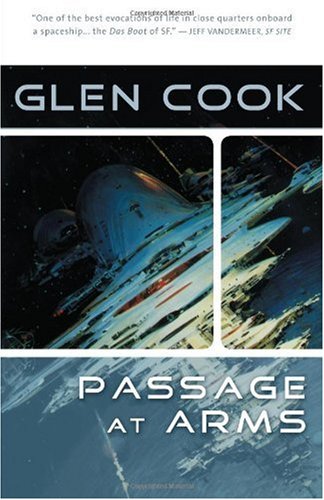
My earliest encounter with his work was the first three or four books of The Annals of the Black Company and, later, The Garrett Files, back when I was just a wee young whelp blazing through as many tomes from the Fantasy and Science Fiction Book Club as I could get my hands on. Later, I read (and loved) The Dragon Never Sleeps, a stand-alone space opera that I found a used copy of a couple of years ago and read again. To my great delight, it was just as good, if not better, the second time around.
So when I recently found myself gazing upon the vast to-read pile that adorns my bookshelves, with an (oddly rare these days) opportunity to read whatever I wanted, I leapt at the chance to read Passage At Arms, one of his lesser known works, a military SF standalone that is, in the words of my esteemed Clarion instructor (and literary hero) Jeff VanderMeer, the "Das Boot of SF." If you look at the picture above closely enough, you can see where he says it, there at the top, above Cook's byline.
Synoptically speaking, Passage at Arms is a first-person narrative account of one ship's patrol into unfriendly space during a protracted war between humanity and an alien race called the Ulant. Told from the perspective of a discharged Navy Lieutenant turned war correspondent, the story revolves primarily around the claustrophobia and paranoia of the crew on their months-long patrol through the vicissitudes and uncertainty of war in space. Despite its science fictional premise, there's a certain verisimilitude here that really brings things home. The narrow focus on surviving the present; the lack of information; the contempt for Command: it all rings true. It all sounds like what it's really like to be at war, or would be, under those circumstances.
Tuesday, October 05, 2010
Worthy Quotations
One of the great rewards of a writer's life is that it lets you read all the books you want to without feeling guilty.
-Damon Knight
Monday, October 04, 2010
Reading and Writing 10/4/10

Why? you ask. Well, I'm glad you did (which is why I did it for you).
Friday, September 24, 2010
Reader's Journal 9/24/10
 A few days ago, I finally finished the second half of Roberto Bolaño's 2666. I'd begun it way back in February or March, right around the time I was applying to/frantically writing stories for the Clarion workshop, and I'd got about halfway through it by the time I was accepted (you can read my thoughts about it then here). I put it down at that point, partly because it was pretty overwhelming as a work of fiction, but mostly because I suddenly had a lot of reading to do in order to prepare for the workshop. After it was over (and I'd finished reading The Windup Girl, by Paolo Bacigalupi, which I read for fun at Clarion (you know, in all my spare time), and which I really enjoyed, and will hopefully remember to write about sometime), and I had returned home, I decided to pick it back up again.
As I recollect, I'd blown through the first of the five books, The Part About the Critics, very quickly, getting lost in the intertwinings of the the professional (and personal) lives of a group of Eurpoean academics whose scholarly work revolved around the books of a German author named Benno Von Archimboldi. Archimboldi bookends 2666, as the subject of scholarly interest in his work in the first book, and as the protagonist or at least the subject of the fifth. One can only assume that his (tenuous, ambiguous, possbily illusory) connection to the three middle books, which deal with the imaginary Mexican city of Santa Teresa (modeled, I have it on good authority, on Ciudad Juarez), comprises the mystery that Bolaño invites the reader to... well, not really solve, but perhaps explore, since it seems to be one of Bolaño's central artistic tenets (at least so far as 2666 is concerned) not to solve any mysteries, but merely to present them in all their ineffable squalor and glory, that the reader may contemplate and engage with them on his or her own.
Monday, September 13, 2010
Mad Props!
To Tom Underberg and Kali Wallace, two of my Clarion classmates whose entries were selected for the Thackery T. Lambshead's Cabinet of Curiosities anthology. Good job, guys.
An explanation of what I'm talking about, along with all of the submissions, can be found here.
And, for what it's worth, here's mine, slightly redacted:
WOODEN STAKE. 8-3/8” long, base diameter 1-15/16” tapering to a sharp point. Item was mistaken for a structural element of the cabinet until the discovery, in a separate wax-sealed box, of a note dated September 1735. Signed by Drs. Flückinger and Glaser, the note identifies the item as the hawthorne stake driven through the heart of Arnont Paule’s exhumed corpse in the village of Medveda in Serbian Moravia, ca. 1726 (the posthumous certifications of Paule and Petar Blagojević by Austro-Hungarian medical authorities are considered proximate causes of the Eighteenth Century Vampire Controversy). Dendrochonological analyses confirm item to be fire-hardened Crataegus monogyna, 250-350 years old. Haematology samples reveal certain unexplained irregularities and traces of at least five individuals’ genetic material. Dr. L-------- is believed to have won the item from a bastard son of Otto Habsburg-Lothringen in a card game in Paris in 1967.
Writer's Journal 9/12/10
Today's been downright writerful, all things considered. Woke up and spent the morning doing critiques for my new writing group (or, rather, the already-established writing group that was kind enough to welcome me as a new member), finishing just in time to make the meeting in a punctual manner. Seemed like a productive session. I feel like it's probably about time for me to submit something for critique, though I'm not quite sure what. Of the things I wrote at Clarion (which comprise the bulk of my shorter work), I've only revised one, and it seems like kind of a waste to workshop any of the rest, at least until I've had a chance to fool around with them some and fix the problems I know are there. I suppose that means that the thing to submit is the one I've revised, but for some reason I left the session with the ambition that I would pick another one and fix it up for everybody (and, of course, it was one of the ones I haven't really thought about much yet, because that's how I roll).
I need to be careful about that, though. After all, the plan is to stay focused on the (hopefully short) novel I've been developing for the last couple weeks. I have not been terribly productive of late (hence the paucity of Writer's Journal posts here, or any posts at all for that matter, aside from my habit of passing along various and assorted pithy encapsulations and quotable quotes for your delectation and delight).
Partly, it's that my regularly-scheduled life has taken up a fair bit of my time; I'm currently in the midst of reorganizing my files and paperwork and such, with an eye towards getting my various taking-care-of-business-type stuff wrestled into manageable and comprehensible form. I was also, until Friday night, organizing a surprise birthday party for my lovely and awesome girlfriend Kendal, (in the Pussy Room at the Copper Gate in Ballard; later the two of us wandered down to Ocho, which is where I took Kendal on our first date (and have taken her on several subsequent dates), for some late-night tapas and cocktails).
So, partly I've just been busy with life, and not very disciplined about making time to work. But I've also been trying to lay back and let my creative subconscious do its thing. So far it seems to be working. I finally got a chance to sit down and work on the outline a bit tonight, and though I definitely suffered from some focus issues (as I tend to do), I managed to get a fair bit of work done.
I'm kind of excited with this new approach I'm trying, figuring out how it's all going to fit together before I actually start writing it. I've always been a start, and when you get to the end, stop kind of writer, which, given the rate and quantities at which ideas occur to me, has led me down any number of paths that led nowhere besides the conviction that it was time to start over.
So this whole planning things out in advance thing is a really refreshing change.
And it seems to be paying off. Despite my hummingbird's attention span, I still managed to tack 1000 words or so onto the plan tonight, and I seem to be developing a structure (for the plan, at least) that's working for me. I've got much (though not quite all) of part one figured out, two ideas for the prologue that are fighting it out in my head, and the early stages of part two mapped out as well.
The way I'm organizing it is into three sections for each part (there are three in addition to the prologue, provisionally named Camel, Lion, and Child): a summary of what happens and what it means, writing notes (on POV, tone, what's hidden and revealed, etc), and a basic sequence of events. I imagine as I make more passes over the thing, the structure will continue to ramify, but I am pleased so far with how I'm figuring out not only the plot but also how to tie it to the overall structure of the novel. I mean, I've experienced some of these sorts of epiphanies before with my previous project (the giant sprawling mess currently on the backburner while I do this more limited, probably more saleable project), but never in this focused a manner. It's great.
As to the plan going forward, I aspire to have the outlining and preliminary work done in three to four weeks, after which I intend to schedule enough writing time (and keep the project limited enough) to bang out a draft in three to four months (say by mid-January).
I think I'm most of the way to ready to start pushing it a little in terms of engagement. After all, I did much if not most of the heavy lifting at Clarion, concept-wise, and it seems like the ongoing epiphany process seems to be well underway. I've been taking it easy since I got back, waiting while my subconscious reconfigured itself and internalized the many invaluable lessons I learned over the summer. I'm still not quite ready to start writing. But I can feel it coming, and I think my plan, though it'll be intense, is doable, especially if I'm able to keep forging ahead with all this planning and outlining.
The only problem is staying focused, which brings me back to the first paragraph of the present installment of this writer's Writer's Journal. Because I do also want to workshop stories, and critique, and submit for publication and such. But I have some fear that I'll get sidetracked from the project I'm supposed to be working on, so I'm going to have to figure that out. I've thought a little about trying to write some flash fiction (1000 words or less, for those unfamiliar with the term), which doesn't seem like it would be too distracting, and would provide sufficient fodder for submission (and rejection). I just have to think of things that are amenable to being written in that form. But I don't know. Maybe I should stay focused on the project at hand, and let the rest slide, at least until I've got a completed draft.
Either way, it's a pretty exciting place to be.
I need to be careful about that, though. After all, the plan is to stay focused on the (hopefully short) novel I've been developing for the last couple weeks. I have not been terribly productive of late (hence the paucity of Writer's Journal posts here, or any posts at all for that matter, aside from my habit of passing along various and assorted pithy encapsulations and quotable quotes for your delectation and delight).
Partly, it's that my regularly-scheduled life has taken up a fair bit of my time; I'm currently in the midst of reorganizing my files and paperwork and such, with an eye towards getting my various taking-care-of-business-type stuff wrestled into manageable and comprehensible form. I was also, until Friday night, organizing a surprise birthday party for my lovely and awesome girlfriend Kendal, (in the Pussy Room at the Copper Gate in Ballard; later the two of us wandered down to Ocho, which is where I took Kendal on our first date (and have taken her on several subsequent dates), for some late-night tapas and cocktails).

So, partly I've just been busy with life, and not very disciplined about making time to work. But I've also been trying to lay back and let my creative subconscious do its thing. So far it seems to be working. I finally got a chance to sit down and work on the outline a bit tonight, and though I definitely suffered from some focus issues (as I tend to do), I managed to get a fair bit of work done.
I'm kind of excited with this new approach I'm trying, figuring out how it's all going to fit together before I actually start writing it. I've always been a start, and when you get to the end, stop kind of writer, which, given the rate and quantities at which ideas occur to me, has led me down any number of paths that led nowhere besides the conviction that it was time to start over.
So this whole planning things out in advance thing is a really refreshing change.
And it seems to be paying off. Despite my hummingbird's attention span, I still managed to tack 1000 words or so onto the plan tonight, and I seem to be developing a structure (for the plan, at least) that's working for me. I've got much (though not quite all) of part one figured out, two ideas for the prologue that are fighting it out in my head, and the early stages of part two mapped out as well.
The way I'm organizing it is into three sections for each part (there are three in addition to the prologue, provisionally named Camel, Lion, and Child): a summary of what happens and what it means, writing notes (on POV, tone, what's hidden and revealed, etc), and a basic sequence of events. I imagine as I make more passes over the thing, the structure will continue to ramify, but I am pleased so far with how I'm figuring out not only the plot but also how to tie it to the overall structure of the novel. I mean, I've experienced some of these sorts of epiphanies before with my previous project (the giant sprawling mess currently on the backburner while I do this more limited, probably more saleable project), but never in this focused a manner. It's great.
As to the plan going forward, I aspire to have the outlining and preliminary work done in three to four weeks, after which I intend to schedule enough writing time (and keep the project limited enough) to bang out a draft in three to four months (say by mid-January).
I think I'm most of the way to ready to start pushing it a little in terms of engagement. After all, I did much if not most of the heavy lifting at Clarion, concept-wise, and it seems like the ongoing epiphany process seems to be well underway. I've been taking it easy since I got back, waiting while my subconscious reconfigured itself and internalized the many invaluable lessons I learned over the summer. I'm still not quite ready to start writing. But I can feel it coming, and I think my plan, though it'll be intense, is doable, especially if I'm able to keep forging ahead with all this planning and outlining.
The only problem is staying focused, which brings me back to the first paragraph of the present installment of this writer's Writer's Journal. Because I do also want to workshop stories, and critique, and submit for publication and such. But I have some fear that I'll get sidetracked from the project I'm supposed to be working on, so I'm going to have to figure that out. I've thought a little about trying to write some flash fiction (1000 words or less, for those unfamiliar with the term), which doesn't seem like it would be too distracting, and would provide sufficient fodder for submission (and rejection). I just have to think of things that are amenable to being written in that form. But I don't know. Maybe I should stay focused on the project at hand, and let the rest slide, at least until I've got a completed draft.
Either way, it's a pretty exciting place to be.
Sunday, September 05, 2010
Why Damon Knight was Famous and I'm Not
Real life does not often furnish a dramatic series; if it did, our instinct for order and design would be satisfied, and very likely we would feel no need for fiction.See, it's just like what I said, only pithier and more insightful.
-Damon Knight, Creating Short Fiction p 90
I've been reading Creating Short Fiction off and on for the last week or two, and it's pretty freakin' fantastic. I wish I'd read it before Clarion, so as to avoid some of the rookie mistakes that I made there, and I'm pretty sure I'll end up reading it (or parts of it) over and over again, until I have finally and fully absorbed the many, many invaluable lessons on craft and storytelling it contains.
It's out of print, but if you or someone you love wants to be a writer, or a better one that you/they already are, I can't recommend this book enough.
While I'm at it, I also highly recommend Kate Wilhelm's Storyteller. The two of them pretty much invented the Clarion Writers' Workshop, and, in addition to successful careers as writers, they taught writing (or what of writing can be taught, which is a post for another day) for decades, and both of them have a lot to say about how it's done sucessfully.
It's funny; I spent many years convinced that I could figure out how to write on my own, and in some senses I was right. But it sure is a lot easier when you have such handy guides to the nuts and bolts of things. Wish I'd picked up both of these many years ago.
Subscribe to:
Posts (Atom)